






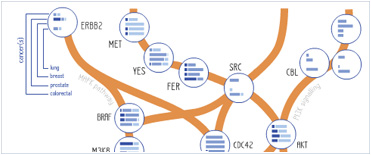








 Foundational characteristics of cancer include proliferation, angiogenesis, migration, evasion of apoptosis, and cellular immortality. Find key markers for these cellular processes and antibodies to detect them.
 The SUMOplot™ Analysis Program predicts and scores sumoylation sites in your protein. SUMOylation is a post-translational modification involved in various cellular processes, such as nuclear-cytosolic transport, transcriptional regulation, apoptosis, protein stability, response to stress, and progression through the cell cycle.
 The Autophagy Receptor Motif Plotter predicts and scores autophagy receptor binding sites in your protein. Identifying proteins connected to this pathway is critical to understanding the role of autophagy in physiological as well as pathological processes such as development, differentiation, neurodegenerative diseases, stress, infection, and cancer.
MST1 Antibody (C-term) Blocking peptide
Synthetic peptide
- SPECIFICATION
- CITATIONS
- PROTOCOLS
- BACKGROUND
| Primary Accession | P26927 |
|---|---|
| Clone Names | 100318005 |
| Gene ID | 4485 |
|---|---|
| Other Names | Hepatocyte growth factor-like protein, Macrophage stimulatory protein, Macrophage-stimulating protein, MSP, Hepatocyte growth factor-like protein alpha chain, Hepatocyte growth factor-like protein beta chain, MST1, D3F15S2, DNF15S2, HGFL |
| Format | Peptides are lyophilized in a solid powder format. Peptides can be reconstituted in solution using the appropriate buffer as needed. |
| Storage | Maintain refrigerated at 2-8°C for up to 6 months. For long term storage store at -20°C. |
| Precautions | This product is for research use only. Not for use in diagnostic or therapeutic procedures. |
| Name | MST1 |
|---|---|
| Synonyms | D3F15S2, DNF15S2, HGFL |
| Cellular Location | Secreted. |

Thousands of laboratories across the world have published research that depended on the performance of antibodies from Abcepta to advance their research. Check out links to articles that cite our products in major peer-reviewed journals, organized by research category.
info@abcepta.com, and receive a free "I Love Antibodies" mug.

Provided below are standard protocols that you may find useful for product applications.
Background
The protein encoded by this gene contains four kringledomains and a serine protease domain, similar to that found inhepatic growth factor. Despite the presence of the serine proteasedomain, the encoded protein may not have any proteolytic activity.The receptor for this protein is RON tyrosine kinase, which uponactivation stimulates ciliary motility of ciliated epithelial lungcells. This protein is secreted and cleaved to form an alpha chainand a beta chain bridged by disulfide bonds.
References
Latiano, A., et al. Inflamm. Bowel Dis. 16(7):1108-1117(2010)Morgan, A.R., et al. Hum. Immunol. 71(6):602-609(2010)Qiao, M., et al. Mol. Cell 38(4):512-523(2010)McGovern, D.P., et al. Nat. Genet. 42(4):332-337(2010)Oh, H.J., et al. Curr. Biol. 20(5):416-422(2010)

If you have used an Abcepta product and would like to share how it has performed, please click on the "Submit Review" button and provide the requested information. Our staff will examine and post your review and contact you if needed.
If you have any additional inquiries please email technical services at tech@abcepta.com.

Ordering Information
Other Products
Shipping Information