














 Foundational characteristics of cancer include proliferation, angiogenesis, migration, evasion of apoptosis, and cellular immortality. Find key markers for these cellular processes and antibodies to detect them.
 The SUMOplot™ Analysis Program predicts and scores sumoylation sites in your protein. SUMOylation is a post-translational modification involved in various cellular processes, such as nuclear-cytosolic transport, transcriptional regulation, apoptosis, protein stability, response to stress, and progression through the cell cycle.
 The Autophagy Receptor Motif Plotter predicts and scores autophagy receptor binding sites in your protein. Identifying proteins connected to this pathway is critical to understanding the role of autophagy in physiological as well as pathological processes such as development, differentiation, neurodegenerative diseases, stress, infection, and cancer.
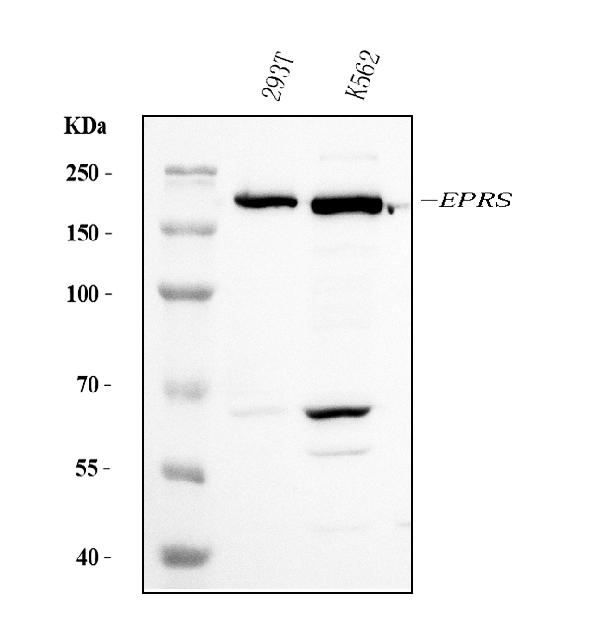
Anti-EPRS1/PARS Antibody Picoband™ (monoclonal, 8G9C7)
- SPECIFICATION
- CITATIONS
- PROTOCOLS
- BACKGROUND

Application 
| WB, IHC, IF, ICC, FC |
|---|---|
| Primary Accession | P07814 |
| Host | Mouse |
| Isotype | Mouse IgG2a |
| Reactivity | Human |
| Clonality | Monoclonal |
| Format | Lyophilized |
| Description | Anti-EPRS1/PARS Antibody Picoband™ (monoclonal, 8G9C7) . Tested in Flow Cytometry, IF, IHC, ICC, WB applications. This antibody reacts with Human. |
| Reconstitution | Adding 0.2 ml of distilled water will yield a concentration of 500 µg/ml. |
| Gene ID | 2058 |
|---|---|
| Other Names | Bifunctional glutamate/proline--tRNA ligase, Bifunctional aminoacyl-tRNA synthetase, Cell proliferation-inducing gene 32 protein {ECO:0000312|EMBL:AAS72877.1}, Glutamatyl-prolyl-tRNA synthetase {ECO:0000312|HGNC:HGNC:3418}, Glutamate--tRNA ligase, 6.1.1.17, Glutamyl-tRNA synthetase, GluRS, Proline--tRNA ligase, 6.1.1.15, Prolyl-tRNA synthetase, EPRS1 (HGNC:3418) |
| Calculated MW | 170-180 kDa |
| Application Details | Western blot, 0.25-0.5 µg/ml, Human Immunohistochemistry(Paraffin-embedded Section), 2-5 µg/ml, Human Immunocytochemistry/Immunofluorescence, 5 µg/ml, Human Flow Cytometry, 1-3 µg/1x10^6 cells, Human |
| Contents | Each vial contains 4 mg Trehalose, 0.9 mg NaCl and 0.2 mg Na2HPO4. |
| Clone Names | Clone: 8G9C7 |
| Immunogen | E.coli-derived human EPRS1/PARS recombinant protein (Position: R1298-Y1512). |
| Purification | Immunogen affinity purified. |
| Storage | At -20°C for one year from date of receipt. After reconstitution, at 4°C for one month. It can also be aliquotted and stored frozen at -20°C for six months. Avoid repeated freezing and thawing. |
| Name | EPRS1 (HGNC:3418) |
|---|---|
| Function | Multifunctional protein which primarily functions within the aminoacyl-tRNA synthetase multienzyme complex, also known as multisynthetase complex. Within the complex it catalyzes the attachment of both L-glutamate and L-proline to their cognate tRNAs in a two-step reaction where the amino acid is first activated by ATP to form a covalent intermediate with AMP. Subsequently, the activated amino acid is transferred to the acceptor end of the cognate tRNA to form L- glutamyl-tRNA(Glu) and L-prolyl-tRNA(Pro) (PubMed:23263184, PubMed:24100331, PubMed:29576217, PubMed:3290852, PubMed:37212275). Upon interferon-gamma stimulation, EPRS1 undergoes phosphorylation, causing its dissociation from the aminoacyl-tRNA synthetase multienzyme complex. It is recruited to form the GAIT complex, which binds to stem loop-containing GAIT elements found in the 3'-UTR of various inflammatory mRNAs, such as ceruloplasmin. The GAIT complex inhibits the translation of these mRNAs, allowing interferon-gamma to redirect the function of EPRS1 from protein synthesis to translation inhibition in specific cell contexts (PubMed:15479637, PubMed:23071094). Furthermore, it can function as a downstream effector in the mTORC1 signaling pathway, by promoting the translocation of SLC27A1 from the cytoplasm to the plasma membrane where it mediates the uptake of long- chain fatty acid by adipocytes. Thereby, EPRS1 also plays a role in fat metabolism and more indirectly influences lifespan (PubMed:28178239). |
| Cellular Location | Cytoplasm, cytosol. Membrane; Peripheral membrane protein Note=Translocates from cytosol to membranes upon phosphorylation at Ser-999. |

Thousands of laboratories across the world have published research that depended on the performance of antibodies from Abcepta to advance their research. Check out links to articles that cite our products in major peer-reviewed journals, organized by research category.
info@abcepta.com, and receive a free "I Love Antibodies" mug.

Provided below are standard protocols that you may find useful for product applications.
Background
Bifunctional aminoacyl-tRNA synthetase is an enzyme that in humans is encoded by the EPRS gene. Aminoacyl-tRNA synthetases are a class of enzymes that charge tRNAs with their cognate amino acids. The protein encoded by this gene is a multifunctional aminoacyl-tRNA synthetase that catalyzes the aminoacylation of glutamic acid and proline tRNA species. Alternative splicing has been observed for this gene, but the full-length nature and biological validity of the variant have not been determined.

If you have used an Abcepta product and would like to share how it has performed, please click on the "Submit Review" button and provide the requested information. Our staff will examine and post your review and contact you if needed.
If you have any additional inquiries please email technical services at tech@abcepta.com.

Ordering Information
Other Products
Shipping Information