






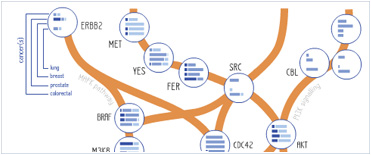








 Foundational characteristics of cancer include proliferation, angiogenesis, migration, evasion of apoptosis, and cellular immortality. Find key markers for these cellular processes and antibodies to detect them.
 The SUMOplot™ Analysis Program predicts and scores sumoylation sites in your protein. SUMOylation is a post-translational modification involved in various cellular processes, such as nuclear-cytosolic transport, transcriptional regulation, apoptosis, protein stability, response to stress, and progression through the cell cycle.
 The Autophagy Receptor Motif Plotter predicts and scores autophagy receptor binding sites in your protein. Identifying proteins connected to this pathway is critical to understanding the role of autophagy in physiological as well as pathological processes such as development, differentiation, neurodegenerative diseases, stress, infection, and cancer.
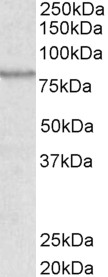
Goat Anti-ABCB5 Antibody
Peptide-affinity purified goat antibody
- SPECIFICATION
- CITATIONS
- PROTOCOLS
- BACKGROUND

Application 
| WB, FC, E |
|---|---|
| Primary Accession | Q2M3G0 |
| Other Accession | NP_848654, 340273 |
| Reactivity | Human |
| Host | Goat |
| Clonality | Polyclonal |
| Concentration | 100ug/200ul |
| Isotype | IgG |
| Calculated MW | 138641 Da |
| Gene ID | 340273 |
|---|---|
| Other Names | ATP-binding cassette sub-family B member 5, ABCB5 P-gp, P-glycoprotein ABCB5, ABCB5 |
| Dilution | WB~~1:1000 FC~~1:10~50 E~~N/A |
| Format | 0.5 mg IgG/ml in Tris saline (20mM Tris pH7.3, 150mM NaCl), 0.02% sodium azide, with 0.5% bovine serum albumin |
| Storage | Maintain refrigerated at 2-8°C for up to 6 months. For long term storage store at -20°C in small aliquots to prevent freeze-thaw cycles. |
| Precautions | Goat Anti-ABCB5 Antibody is for research use only and not for use in diagnostic or therapeutic procedures. |
| Name | ABCB5 (HGNC:46) |
|---|---|
| Function | Energy-dependent efflux transporter responsible for decreased drug accumulation in multidrug-resistant cells (PubMed:12960149, PubMed:15205344, PubMed:15899824, PubMed:22306008). Specifically present in limbal stem cells, where it plays a key role in corneal development and repair (By similarity). |
| Cellular Location | Cell membrane; Multi-pass membrane protein {ECO:0000255|PROSITE-ProRule:PRU00441, ECO:0000269|PubMed:12960149} |
| Tissue Location | Expressed by CD133-expressing progenitor cells among epidermal melanocytes (at protein level). Widely expressed with specific expression in pigment cells. Highly expressed in several malignant tissues: highly expressed in clinical melanomas, with low expression in normal skin. In melanoma, marks malignant melanoma- initiating cells (MMIC), in which clinical virulence resides as a consequence of unlimited self-renewal capacity, resulting in inexorable tumor progression and metastasis. Also highly expressed in a number of leukemia cells. Expressed in basal limbal epithelium |

Thousands of laboratories across the world have published research that depended on the performance of antibodies from Abcepta to advance their research. Check out links to articles that cite our products in major peer-reviewed journals, organized by research category.
info@abcepta.com, and receive a free "I Love Antibodies" mug.

Provided below are standard protocols that you may find useful for product applications.
Background
ABCB5 belongs to the ATP-binding cassette (ABC) transporter superfamily of integral membrane proteins. These proteins participate in ATP-dependent transmembrane transport of structurally diverse molecules ranging from small ions, sugars, and peptides to more complex organic molecules (Chen et al., 2005 [PubMed 15760339]).
References
ABCB5 gene amplification in human leukemia cells. Frank NY, et al. Leuk Res, 2009 Oct. PMID 19477512.
Identification of cells initiating human melanomas. Schatton T, et al. Nature, 2008 Jan 17. PMID 18202660.
The Role of heat shock protein 27 in extravillous trophoblast differentiation. Matalon ST, et al. J Cell Biochem, 2008 Feb 15. PMID 17661346.
ABCB5-mediated doxorubicin transport and chemoresistance in human malignant melanoma. Frank NY, et al. Cancer Res, 2005 May 15. PMID 15899824.
Principal expression of two mRNA isoforms (ABCB 5alpha and ABCB 5beta ) of the ATP-binding cassette transporter gene ABCB 5 in melanoma cells and melanocytes. Chen KG, et al. Pigment Cell Res, 2005 Apr. PMID 15760339.

If you have used an Abcepta product and would like to share how it has performed, please click on the "Submit Review" button and provide the requested information. Our staff will examine and post your review and contact you if needed.
If you have any additional inquiries please email technical services at tech@abcepta.com.

Ordering Information
Other Products
Shipping Information