






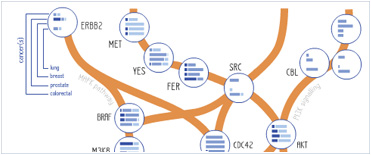








 Foundational characteristics of cancer include proliferation, angiogenesis, migration, evasion of apoptosis, and cellular immortality. Find key markers for these cellular processes and antibodies to detect them.
 The SUMOplot™ Analysis Program predicts and scores sumoylation sites in your protein. SUMOylation is a post-translational modification involved in various cellular processes, such as nuclear-cytosolic transport, transcriptional regulation, apoptosis, protein stability, response to stress, and progression through the cell cycle.
 The Autophagy Receptor Motif Plotter predicts and scores autophagy receptor binding sites in your protein. Identifying proteins connected to this pathway is critical to understanding the role of autophagy in physiological as well as pathological processes such as development, differentiation, neurodegenerative diseases, stress, infection, and cancer.
ACSS2 Antibody (Center)
Affinity Purified Rabbit Polyclonal Antibody (Pab)
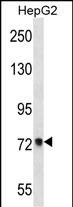
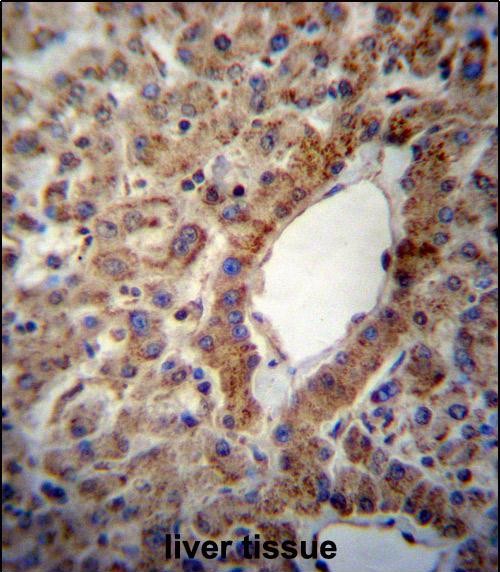
- SPECIFICATION
- CITATIONS
- PROTOCOLS
- BACKGROUND

Application 
| IHC-P, WB, E |
|---|---|
| Primary Accession | Q9NR19 |
| Other Accession | NP_061147.1 |
| Reactivity | Human |
| Host | Rabbit |
| Clonality | Polyclonal |
| Isotype | Rabbit IgG |
| Calculated MW | 78580 Da |
| Antigen Region | 261-290 aa |
| Gene ID | 55902 |
|---|---|
| Other Names | Acetyl-coenzyme A synthetase, cytoplasmic, Acetate--CoA ligase, Acetyl-CoA synthetase, ACS, AceCS, Acyl-CoA synthetase short-chain family member 2, Acyl-activating enzyme, ACSS2, ACAS2 |
| Target/Specificity | This ACSS2 antibody is generated from rabbits immunized with a KLH conjugated synthetic peptide between 261-290 amino acids from the Central region of human ACSS2. |
| Dilution | IHC-P~~1:10~50 WB~~1:1000 E~~Use at an assay dependent concentration. |
| Format | Purified polyclonal antibody supplied in PBS with 0.09% (W/V) sodium azide. This antibody is purified through a protein A column, followed by peptide affinity purification. |
| Storage | Maintain refrigerated at 2-8°C for up to 2 weeks. For long term storage store at -20°C in small aliquots to prevent freeze-thaw cycles. |
| Precautions | ACSS2 Antibody (Center) is for research use only and not for use in diagnostic or therapeutic procedures. |
| Name | ACSS2 |
|---|---|
| Synonyms | ACAS2 |
| Function | Catalyzes the synthesis of acetyl-CoA from short-chain fatty acids (PubMed:10843999, PubMed:28003429, PubMed:28552616). Acetate is the preferred substrate (PubMed:10843999, PubMed:28003429). Can also utilize propionate with a much lower affinity (By similarity). Nuclear ACSS2 promotes glucose deprivation-induced lysosomal biogenesis and autophagy, tumor cell survival and brain tumorigenesis (PubMed:28552616). Glucose deprivation results in AMPK-mediated phosphorylation of ACSS2 leading to its translocation to the nucleus where it binds to TFEB and locally produces acetyl-CoA for histone acetylation in the promoter regions of TFEB target genes thereby activating their transcription (PubMed:28552616). The regulation of genes associated with autophagy and lysosomal activity through ACSS2 is important for brain tumorigenesis and tumor survival (PubMed:28552616). Acts as a chromatin-bound transcriptional coactivator that up-regulates histone acetylation and expression of neuronal genes (By similarity). Can be recruited to the loci of memory-related neuronal genes to maintain a local acetyl-CoA pool, providing the substrate for histone acetylation and promoting the expression of specific genes, which is essential for maintaining long-term spatial memory (By similarity). |
| Cellular Location | Cytoplasm, cytosol. Cytoplasm {ECO:0000250|UniProtKB:Q9QXG4}. Nucleus Note=Glucose deprivation results in its AMPK-dependent phosphorylation and subsequent nuclear translocation (PubMed:28552616). Phosphorylation at Ser-659, leads to exposure of its nuclear localization signal which is required for its interaction with KPNA1 and subsequent translocation to the nucleus (PubMed:28552616). Found in the cytoplasm in undifferentiated neurons and upon differentiation, translocates to nucleus (By similarity). {ECO:0000250|UniProtKB:Q9QXG4, ECO:0000269|PubMed:28552616} |

Thousands of laboratories across the world have published research that depended on the performance of antibodies from Abcepta to advance their research. Check out links to articles that cite our products in major peer-reviewed journals, organized by research category.
info@abcepta.com, and receive a free "I Love Antibodies" mug.

Provided below are standard protocols that you may find useful for product applications.
Background
This gene encodes a cytosolic enzyme that catalyzes the activation of acetate for use in lipid synthesis and energy generation. The protein acts as a monomer and produces acetyl-CoA from acetate in a reaction that requires ATP. Expression of this gene is regulated by sterol regulatory element-binding proteins, transcription factors that activate genes required for the synthesis of cholesterol and unsaturated fatty acids. Alternative splicing results in multiple transcript variants. [provided by RefSeq].
References
Bailey, S.D., et al. Diabetes Care 33(10):2250-2253(2010)
Yilmaz, S., et al. Genomics 96(1):57-65(2010)
Ban, H.J., et al. BMC Genet. 11, 26 (2010) :
Talmud, P.J., et al. Am. J. Hum. Genet. 85(5):628-642(2009)
Yun, M., et al. J. Nucl. Med. 50(8):1222-1228(2009)

If you have used an Abcepta product and would like to share how it has performed, please click on the "Submit Review" button and provide the requested information. Our staff will examine and post your review and contact you if needed.
If you have any additional inquiries please email technical services at tech@abcepta.com.

Ordering Information
Other Products
Shipping Information