






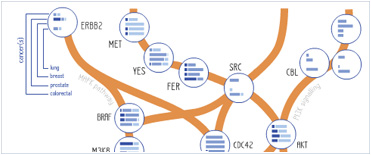








 Foundational characteristics of cancer include proliferation, angiogenesis, migration, evasion of apoptosis, and cellular immortality. Find key markers for these cellular processes and antibodies to detect them.
 The SUMOplot™ Analysis Program predicts and scores sumoylation sites in your protein. SUMOylation is a post-translational modification involved in various cellular processes, such as nuclear-cytosolic transport, transcriptional regulation, apoptosis, protein stability, response to stress, and progression through the cell cycle.
 The Autophagy Receptor Motif Plotter predicts and scores autophagy receptor binding sites in your protein. Identifying proteins connected to this pathway is critical to understanding the role of autophagy in physiological as well as pathological processes such as development, differentiation, neurodegenerative diseases, stress, infection, and cancer.
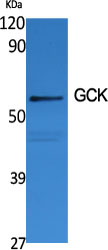
GCK Polyclonal Antibody
.jpg)
- SPECIFICATION
- CITATIONS
- PROTOCOLS
- BACKGROUND

Application 
| WB |
|---|---|
| Primary Accession | P35557 |
| Reactivity | Human, Mouse, Rat |
| Host | Rabbit |
| Clonality | Polyclonal |
| Calculated MW | 52191 Da |
| Gene ID | 2645 |
|---|---|
| Other Names | GCK; Glucokinase; Hexokinase type IV; HK IV; Hexokinase-4; HK4; Hexokinase-D |
| Dilution | WB~~Western Blot: 1/500 - 1/2000. ELISA: 1/10000. Not yet tested in other applications. |
| Format | Liquid in PBS containing 50% glycerol, 0.5% BSA and 0.09% (W/V) sodium azide. |
| Storage Conditions | -20℃ |
| Name | GCK {ECO:0000303|PubMed:17573900, ECO:0000312|HGNC:HGNC:4195} |
|---|---|
| Function | Catalyzes the phosphorylation of hexose, such as D-glucose, D-fructose and D-mannose, to hexose 6-phosphate (D-glucose 6-phosphate, D-fructose 6-phosphate and D-mannose 6-phosphate, respectively) (PubMed:11916951, PubMed:15277402, PubMed:17082186, PubMed:18322640, PubMed:19146401, PubMed:25015100, PubMed:7742312, PubMed:8325892). Compared to other hexokinases, has a weak affinity for D-glucose, and is effective only when glucose is abundant (By similarity). Mainly expressed in pancreatic beta cells and the liver and constitutes a rate-limiting step in glucose metabolism in these tissues (PubMed:11916951, PubMed:15277402, PubMed:18322640, PubMed:25015100, PubMed:8325892). Since insulin secretion parallels glucose metabolism and the low glucose affinity of GCK ensures that it can change its enzymatic activity within the physiological range of glucose concentrations, GCK acts as a glucose sensor in the pancreatic beta cell (By similarity). In pancreas, plays an important role in modulating insulin secretion (By similarity). In liver, helps to facilitate the uptake and conversion of glucose by acting as an insulin-sensitive determinant of hepatic glucose usage (By similarity). Required to provide D-glucose 6-phosphate for the synthesis of glycogen (PubMed:8878425). Mediates the initial step of glycolysis by catalyzing phosphorylation of D-glucose to D-glucose 6-phosphate (PubMed:7742312). |
| Cellular Location | Cytoplasm. Nucleus. Mitochondrion {ECO:0000250|UniProtKB:P17712}. Note=Under low glucose concentrations, GCK associates with GCKR and the inactive complex is recruited to the hepatocyte nucleus. |

Thousands of laboratories across the world have published research that depended on the performance of antibodies from Abcepta to advance their research. Check out links to articles that cite our products in major peer-reviewed journals, organized by research category.
info@abcepta.com, and receive a free "I Love Antibodies" mug.

Provided below are standard protocols that you may find useful for product applications.
Background
Catalyzes the initial step in utilization of glucose by the beta-cell and liver at physiological glucose concentration. Glucokinase has a high Km for glucose, and so it is effective only when glucose is abundant. The role of GCK is to provide G6P for the synthesis of glycogen. Pancreatic glucokinase plays an important role in modulating insulin secretion. Hepatic glucokinase helps to facilitate the uptake and conversion of glucose by acting as an insulin-sensitive determinant of hepatic glucose usage.

If you have used an Abcepta product and would like to share how it has performed, please click on the "Submit Review" button and provide the requested information. Our staff will examine and post your review and contact you if needed.
If you have any additional inquiries please email technical services at tech@abcepta.com.

Ordering Information
Other Products
Shipping Information