






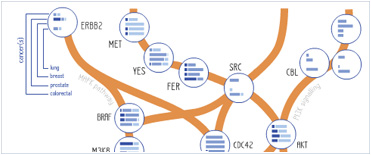








 Foundational characteristics of cancer include proliferation, angiogenesis, migration, evasion of apoptosis, and cellular immortality. Find key markers for these cellular processes and antibodies to detect them.
 The SUMOplot™ Analysis Program predicts and scores sumoylation sites in your protein. SUMOylation is a post-translational modification involved in various cellular processes, such as nuclear-cytosolic transport, transcriptional regulation, apoptosis, protein stability, response to stress, and progression through the cell cycle.
 The Autophagy Receptor Motif Plotter predicts and scores autophagy receptor binding sites in your protein. Identifying proteins connected to this pathway is critical to understanding the role of autophagy in physiological as well as pathological processes such as development, differentiation, neurodegenerative diseases, stress, infection, and cancer.
TCC52 Antibody

- SPECIFICATION
- CITATIONS
- PROTOCOLS
- BACKGROUND

Application 
| WB, ICC, E |
|---|---|
| Primary Accession | Q5T6F0 |
| Other Accession | NP_056212, 22218619 |
| Reactivity | Human, Mouse, Rat |
| Host | Chicken |
| Clonality | Polyclonal |
| Isotype | IgY |
| Calculated MW | 50517 Da |
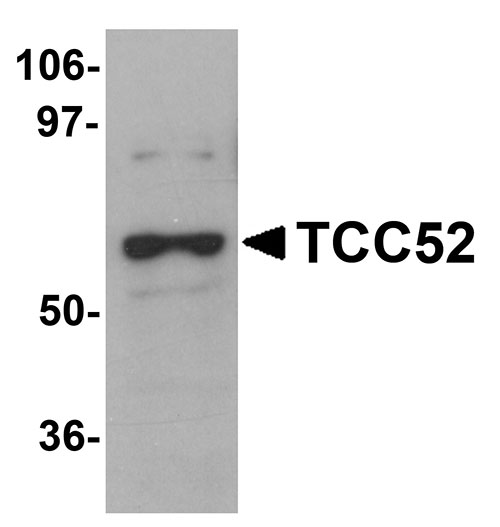
| Application Notes | TCC52 antibody can be used for detection of TCC52 by Western blot at 1 µg/mL. Antibody can also be used for immunocytochemistry starting at 2.5 µg/mL. |
| Gene ID | 25853 |
|---|---|
| Target/Specificity | DCAF12; |
| Reconstitution & Storage | TCC52 antibody can be stored at 4℃ for three months and -20℃, stable for up to one year. As with all antibodies care should be taken to avoid repeated freeze thaw cycles. Antibodies should not be exposed to prolonged high temperatures. |
| Precautions | TCC52 Antibody is for research use only and not for use in diagnostic or therapeutic procedures. |
| Name | DCAF12 {ECO:0000303|PubMed:16949367, ECO:0000312|HGNC:HGNC:19911} |
|---|---|
| Function | Substrate-recognition component of a DCX (DDB1-CUL4-X-box) E3 ubiquitin-protein ligase complex of the DesCEND (destruction via C-end degrons) pathway, which recognizes a C-degron located at the extreme C terminus of target proteins, leading to their ubiquitination and degradation (PubMed:16949367, PubMed:16964240, PubMed:29779948). The C- degron recognized by the DesCEND pathway is usually a motif of less than ten residues and can be present in full-length proteins, truncated proteins or proteolytically cleaved forms (PubMed:29779948). The DCX(DCAF12) complex specifically recognizes proteins with a diglutamate (Glu-Glu) at the C-terminus, such as MAGEA3, MAGEA6 and CCT5, leading to their ubiquitination and degradation (PubMed:29779948, PubMed:31267705). Ubiquitination of MAGEA3, MAGEA6 by DCX(DCAF12) complex is required for starvation-induced autophagy (PubMed:31267705). Also directly recognizes the C-terminal glutamate-leucine (Glu-Leu) degron as an alternative degron in proteins such as MOV10, leading to their ubiquitination and degradation. Controls the protein level of MOV10 during spermatogenesis and in T cells, especially after their activation (PubMed:34065512). |
| Cellular Location | Cytoplasm. Cytoplasm, cytoskeleton, microtubule organizing center, centrosome. Nucleus |
| Tissue Location | Highly expressed in lung cancer tissues and some cancer cell lines (PubMed:18957058). Restricted expression in normal testis (PubMed:18957058). |

Thousands of laboratories across the world have published research that depended on the performance of antibodies from Abcepta to advance their research. Check out links to articles that cite our products in major peer-reviewed journals, organized by research category.
info@abcepta.com, and receive a free "I Love Antibodies" mug.

Provided below are standard protocols that you may find useful for product applications.
Background
TCC52 Antibody: Cancer-testis (CT) antigens are a type of antigen whose expression is highly restricted, primarily in normal testis, but aberrantly in different tumor types. Their immunogenicity in cancer patients makes them prime targets for immunotherapy of human tumors. One such CT antigen is TCC52, a novel centrosomal protein. TCC52 is a WD repeat-containing protein that interacts with the COP9 signalosome, a macromolecular complex that interacts with cullin-RING E3 ligases and regulates their activity by hydrolyzing cullin-Nedd8 conjugates. The normal biological function of this protein is not known at this time.
References
Scanlan M, Simpson A, and Old L. The cancer/testis genes: review, standardization, and commentary. Cancer Immun.2004; 4:1-15.
Xia L, Li Y, Yang D, et al. Identification of new centrosome proteins by autoimmune patient sera. Sci. China C. Life Sci.2007; 50:194-202.
Li S, Hu X, Cui S, et al. Novel centrosome protein, TCC52, is a cancer-testis antigen. Cancer Sci.2008; 11:2274-9.

If you have used an Abcepta product and would like to share how it has performed, please click on the "Submit Review" button and provide the requested information. Our staff will examine and post your review and contact you if needed.
If you have any additional inquiries please email technical services at tech@abcepta.com.

Ordering Information
Other Products
Shipping Information