






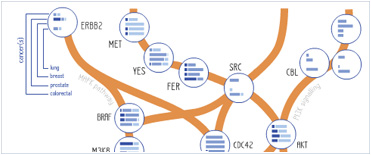








 Foundational characteristics of cancer include proliferation, angiogenesis, migration, evasion of apoptosis, and cellular immortality. Find key markers for these cellular processes and antibodies to detect them.
 The SUMOplot™ Analysis Program predicts and scores sumoylation sites in your protein. SUMOylation is a post-translational modification involved in various cellular processes, such as nuclear-cytosolic transport, transcriptional regulation, apoptosis, protein stability, response to stress, and progression through the cell cycle.
 The Autophagy Receptor Motif Plotter predicts and scores autophagy receptor binding sites in your protein. Identifying proteins connected to this pathway is critical to understanding the role of autophagy in physiological as well as pathological processes such as development, differentiation, neurodegenerative diseases, stress, infection, and cancer.
SHQ1 Antibody
- SPECIFICATION
- CITATIONS
- PROTOCOLS
- BACKGROUND

Application 
| WB, IF, E |
|---|---|
| Primary Accession | Q6PI26 |
| Other Accession | NP_060600, 56550033 |
| Reactivity | Human |
| Host | Rabbit |
| Clonality | Polyclonal |
| Isotype | IgG |
| Calculated MW | 63 kDa |
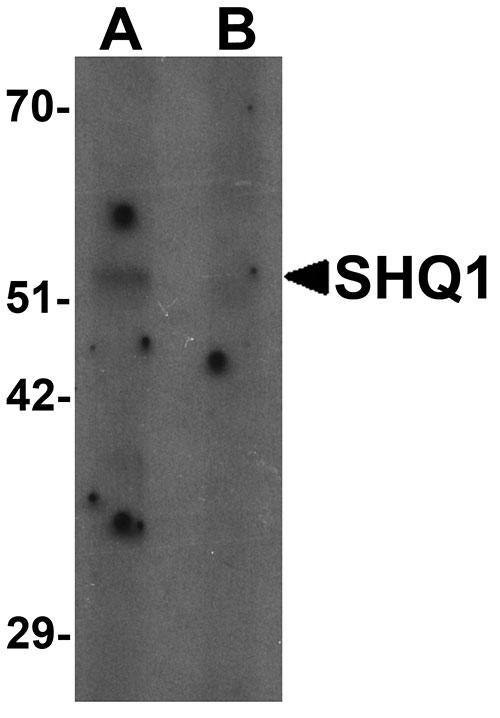
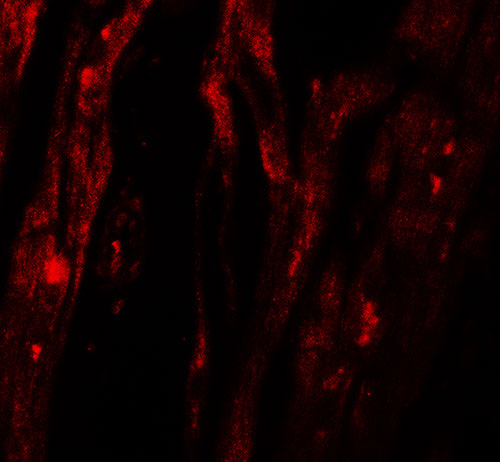
| Application Notes | SHQ1 antibody can be used for detection of SHQ1 by Western blot at 1 µg/mL. For immunofluorescence start at 20 µg/mL. |
| Gene ID | 55164 |
|---|---|
| Target/Specificity | SHQ1; Multiple isoforms are known to exist. |
| Reconstitution & Storage | SHQ1 antibody can be stored at 4℃ for three months and -20℃, stable for up to one year. As with all antibodies care should be taken to avoid repeated freeze thaw cycles. Antibodies should not be exposed to prolonged high temperatures. |
| Precautions | SHQ1 Antibody is for research use only and not for use in diagnostic or therapeutic procedures. |
| Name | SHQ1 |
|---|---|
| Function | Required for the quantitative accumulation of H/ACA ribonucleoproteins (RNPs), including telomerase, probably through the stabilization of DKC1, from the time of its synthesis until its association with NOP10, NHP2, and NAF1 at the nascent H/ACA RNA. |
| Cellular Location | Cytoplasm, cytosol. Nucleus, nucleoplasm. Note=May at least partially shuttle between cytosol and nucleoplasm. In the nucleoplasm, exhibits a granular pattern, but is excluded from nucleoli and Cajal bodies. Absent from most H/ACA-box RNA transcription sites |

Thousands of laboratories across the world have published research that depended on the performance of antibodies from Abcepta to advance their research. Check out links to articles that cite our products in major peer-reviewed journals, organized by research category.
info@abcepta.com, and receive a free "I Love Antibodies" mug.

Provided below are standard protocols that you may find useful for product applications.
Background
SHQ1 Antibody: SHQ1 is the human homolog of yeast Shq1p, a protein that acts as an accessory factor in the assembly of H/ACA ribonucleoproteins. SHQ1 has been shown to bind the major H/ACA core protein and the pseudouridine synthase NAP57, but precedes the assembly role of NAF1 and of the other H/ACA core proteins. SHQ1 assists in the assembly of H/ACA-box ribonucleoproteins that function in the processing of ribosomal RNAs, modification of spliceosomal small nuclear RNAs, and stabilization of telomerase.
References
Ito T, Chiba T, Ozawa R, et al. A comprehensive two-hybrid analysis to explore the yeast protein interactome. Proc. Natl. Acad. Sci. USA 2001; 98:4569-74.
Grozdanov PN, Roy S, Kittur N, et al. SHQ1 is required prior to NAF1 for assembly of H/ACA small nucleolar and telomerase RNPs. RNA 2009; 15:1188-97.

If you have used an Abcepta product and would like to share how it has performed, please click on the "Submit Review" button and provide the requested information. Our staff will examine and post your review and contact you if needed.
If you have any additional inquiries please email technical services at tech@abcepta.com.

Ordering Information
Other Products
Shipping Information