







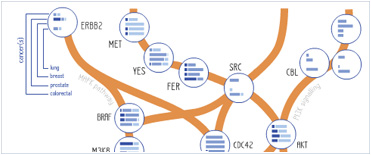








 Foundational characteristics of cancer include proliferation, angiogenesis, migration, evasion of apoptosis, and cellular immortality. Find key markers for these cellular processes and antibodies to detect them.
 The SUMOplot™ Analysis Program predicts and scores sumoylation sites in your protein. SUMOylation is a post-translational modification involved in various cellular processes, such as nuclear-cytosolic transport, transcriptional regulation, apoptosis, protein stability, response to stress, and progression through the cell cycle.
 The Autophagy Receptor Motif Plotter predicts and scores autophagy receptor binding sites in your protein. Identifying proteins connected to this pathway is critical to understanding the role of autophagy in physiological as well as pathological processes such as development, differentiation, neurodegenerative diseases, stress, infection, and cancer.
In Vivo Ready™ Anti-Mouse CD117 (c-Kit) (ACK2) Antibody
- SPECIFICATION
- CITATIONS
- PROTOCOLS
- BACKGROUND

Application 
| WB, IHC-P, FC, ICC, FA |
|---|---|
| Isotype | Rat IgG2b, kappa |
| Concentration | 2 mg/mL |
| Reactivity | Mouse |
| Formulation | 10 mM NaH2PO4, 150 mM NaCl, pH7.2 |
| Host | Rat |
| Gene ID | 16590 |
|---|---|
| Gene Name | Kit |
| Alternative Name(s) | Steel Factor Receptor, SCFR, cKit |
| Format | In Vivo Ready™ |
| Preparation | This monoclonal antibody preparation was purified from tissue culture supernatant via affinity chromatography. For In Vivo Ready™ (IVR) products, each preparation is also evaluated for endotoxin levels using the LAL assay. It is recommended to store the product undiluted at 4°C. Do not freeze. |
| Application Notes | This purified format is guaranteed to be >90% pure as determined by SDS-PAGE analysis. Citations are provided as a convenience to you - please consult Materials and Methods sections for additional details about the use of any product in these publications. |
| Endotoxin Level | Less than or equal to 0.01 EU/ug, as determined by the LaL assay |
| Storage Conditions | 2-8°C |
Tang X, Tian L, Esteso G, Choi S-C, Barrow AD, Colonna M, Borrego F, and Coligan JE. 2012. J. Immunol. 188: 548-558. (Flow cytometry)
Launay J-M, Herve P, Callebert J, Mallat Z, Collet C, Doly S, Belmer A, Diaz SL, Cote F, Humbert M, and Maroteaux L. 2012. Blood. 119: 1772-1780. (Immunohistochemistry - formaldehyde fixed tissue)
Mark-Kappeler CJ, Sen N, Lukefahr A, McKee L, Sipes IG, Konhilas J, and Hoyer PB. 2011. Biol. Reprod. 85: 755-762. (in vitro blocking, Western blot – Fischer 344 Rat)
Kim M-H, Granick JL, Wkok C, Walker NJ, Borjesson DL, Curry F-RE, Miller LS, and Simon SI. 2011. Blood. 117:3343-3352. (in vivo depletion)
Fiorina P, Jurewicz M, Vergani A, Petrelli A, Carvello M, D’Addio F et al. 2011. J. Immunol. 186:121-131. (in vivo blocking)
Stanich JE, Gibbons SJ, Eisenman ST, Bardsley MR, Rock JR, Harfe BD, Ordog T, and Farrugia G. 2011. 301: G1044-G1051. (Immunocytochemistry - acetone fixed cells)
Carlsson IB, Laitinen MPE, Scott JE, Louhio H, Velentzis L, Tuuri T, Aaltonen J, Ritvos O, Winston RML, and Hovatta O. 2006. Reproduction. 131: 641-649. (Immunohistochemistry – paraffin embedded tissue, in vivo blocking)
Provided below are standard protocols that you may find useful for product applications.
Background
The ACK2 antibody is specific for CD117, also called c-Kit, a 145 kDa cytokine receptor important in the development of hematopoietic stem cells, in oogenesis, and for functional activity of immune cells such as NK and mast cells. c-Kit binds to a ligand known as stem cell factor (SCF), or alternatively as mast cell growth factor. Ligand binding promotes the activation (dimerization) and subsequent tyrosine kinase activity of the c-Kit receptor and triggers key survival, expansion and maturation signals during hematopoietic progenitor cell development. Conversely, shedding of extracellular domain of c-Kit receptor is reported to induce inactivation or apoptosis within these cells. The survival signaling activity of c-Kit confers a proto-oncogenic attribute to the receptor, as overexpression or mutations in this protein are associated with tumor development.
The ACK2 antibody is widely utilized as a marker to identify hematopoietic progenitors, and to neutralize receptor-ligand binding in vitro and in vivo. In addition, the antibody is reported to be cross-reactive with rat c-Kit and is extensively published for use in this species.


If you have used an Abcepta product and would like to share how it has performed, please click on the "Submit Review" button and provide the requested information. Our staff will examine and post your review and contact you if needed.
If you have any additional inquiries please email technical services at tech@abcepta.com.

Ordering Information
Other Products
Shipping Information