














 Foundational characteristics of cancer include proliferation, angiogenesis, migration, evasion of apoptosis, and cellular immortality. Find key markers for these cellular processes and antibodies to detect them.
 The SUMOplot™ Analysis Program predicts and scores sumoylation sites in your protein. SUMOylation is a post-translational modification involved in various cellular processes, such as nuclear-cytosolic transport, transcriptional regulation, apoptosis, protein stability, response to stress, and progression through the cell cycle.
 The Autophagy Receptor Motif Plotter predicts and scores autophagy receptor binding sites in your protein. Identifying proteins connected to this pathway is critical to understanding the role of autophagy in physiological as well as pathological processes such as development, differentiation, neurodegenerative diseases, stress, infection, and cancer.
NogoA Antibody
- SPECIFICATION
- CITATIONS
- PROTOCOLS
- BACKGROUND

Application 
| WB, IHC-P, IF, E |
|---|---|
| Primary Accession | Q9NQC3 |
| Other Accession | NP_065393, 24431935 |
| Reactivity | Human, Mouse, Rat |
| Host | Rabbit |
| Clonality | Polyclonal |
| Isotype | IgG |
| Calculated MW | 129931 Da |
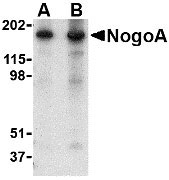
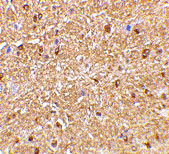
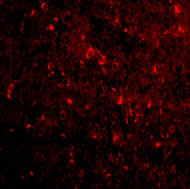
| Application Notes | NogoA antibody can be used for detection of NogoA by Western blot at 0.5 - 1 µg/mL. Despite its predicted molecular weight, NogoA typically migrates at 180 kDa in an SDS-PAGE. Antibody can also be used for immunohistochemistry starting at 2.5 µg/mL. For immunofluorescence start at 20 µg/mL. |
| Gene ID | 57142 |
|---|---|
| Other Names | NogoA Antibody: ASY, NSP, NOGO, NOGOC, RTN-X, NOGO-A, NSP-CL, Nogo-B, Nogo-C, RTN4-A, RTN4-C, RTN4-B1, RTN4-B2, NI220/250, Nbla00271, Nbla10545, KIAA0886, My043, SP1507, Reticulon-4, Foocen, Nogo protein, reticulon 4 |
| Target/Specificity | RTN4; At least five isoforms of Nogo are known to exist; this antibody is specific for NogoA. |
| Reconstitution & Storage | NogoA antibody can be stored at 4℃ for three months and -20℃, stable for up to one year. As with all antibodies care should be taken to avoid repeated freeze thaw cycles. Antibodies should not be exposed to prolonged high temperatures. |
| Precautions | NogoA Antibody is for research use only and not for use in diagnostic or therapeutic procedures. |
| Name | RTN4 (HGNC:14085) |
|---|---|
| Function | Required to induce the formation and stabilization of endoplasmic reticulum (ER) tubules (PubMed:24262037, PubMed:25612671, PubMed:27619977). They regulate membrane morphogenesis in the ER by promoting tubular ER production (PubMed:24262037, PubMed:25612671, PubMed:27619977, PubMed:27786289). They influence nuclear envelope expansion, nuclear pore complex formation and proper localization of inner nuclear membrane proteins (PubMed:26906412). However each isoform have specific functions mainly depending on their tissue expression specificities (Probable). |
| Cellular Location | [Isoform A]: Endoplasmic reticulum membrane; Multi-pass membrane protein. Cell membrane; Multi-pass membrane protein; Cytoplasmic side Synapse {ECO:0000250|UniProtKB:Q99P72}. Note=Anchored to the membrane of the endoplasmic reticulum (ER) through 2 putative transmembrane domains. Localizes throughout the ER tubular network (PubMed:27619977) Co-localizes with TMEM33 at the ER sheets [Isoform C]: Endoplasmic reticulum membrane; Multi-pass membrane protein |
| Tissue Location | Isoform A: is specifically expressed in brain and testis and weakly in heart and skeletal muscle. Isoform B: widely expressed except for the liver. Highly expressed in endothelial cells and vascular smooth muscle cells, including blood vessels and mesenteric arteries (PubMed:15034570, PubMed:21183689). Isoform C: is expressed in brain, skeletal muscle and adipocytes. Isoform D is testis-specific. |

Thousands of laboratories across the world have published research that depended on the performance of antibodies from Abcepta to advance their research. Check out links to articles that cite our products in major peer-reviewed journals, organized by research category.
info@abcepta.com, and receive a free "I Love Antibodies" mug.

Provided below are standard protocols that you may find useful for product applications.
Background
NogoA Antibody: NogoA is a member of a family of integral membrane proteins termed reticulons that are thought to be involved in numerous disorders including neurodegenerative diseases. Reticulon proteins are known to regulate many cellular processes and interact with multiple proteins and receptors such as BACE. NogoA was initially identified as a myelin-associated neurite outgrowth inhibitor. It is highly expressed in oligodendrocytes in the white matter of the CNS; blocking its activity with antibodies or other factors results in improved axon regrowth and functional recovery in experimental CNS lesion models. NogoA has also been suggested to play a role in neurodegenerative diseases such as Amyotrophic lateral sclerosis, in which case NogoA is found at elevated levels in postmortem muscular samples, and multiple sclerosis (MS), in which case autoantibodies to NogoA have been found in serum and cerebrospinal fluid in MS patients.
References
Yan R, ShiQ, Hu X, et al. Reticulon proteins: emerging players in neurodegenerative diseases. Cell. Mol. Life Sci.2006; 63:877-889.
Chen MS, Huber AB, van der Haar ME, et al. Nogo-A is a myelin-associated neurite outgrowth inhibitor and an antigen for monoclonal antibody IN-1. Nature2000; 403:434-9.
Schweigreiter R and Bandtlow CE. Nogo in the injured spinal cord. J. Neurotrauma2006; 3-4:384-96.
Dupuis L, Gonzalez de Aguilar JL, di Scala F, et al. Nogo provides a molecular marker for diagnosis of amyloid lateral sclerosis. Neurobiol. Dis.2002; 10:358-65.

If you have used an Abcepta product and would like to share how it has performed, please click on the "Submit Review" button and provide the requested information. Our staff will examine and post your review and contact you if needed.
If you have any additional inquiries please email technical services at tech@abcepta.com.

Ordering Information
Other Products
Shipping Information