





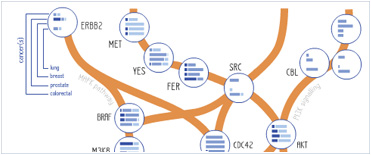








 Foundational characteristics of cancer include proliferation, angiogenesis, migration, evasion of apoptosis, and cellular immortality. Find key markers for these cellular processes and antibodies to detect them.
 The SUMOplot™ Analysis Program predicts and scores sumoylation sites in your protein. SUMOylation is a post-translational modification involved in various cellular processes, such as nuclear-cytosolic transport, transcriptional regulation, apoptosis, protein stability, response to stress, and progression through the cell cycle.
 The Autophagy Receptor Motif Plotter predicts and scores autophagy receptor binding sites in your protein. Identifying proteins connected to this pathway is critical to understanding the role of autophagy in physiological as well as pathological processes such as development, differentiation, neurodegenerative diseases, stress, infection, and cancer.
GOLGIN97 Antibody
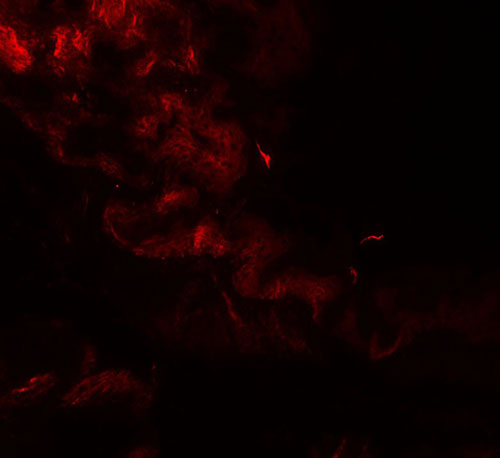
- SPECIFICATION
- CITATIONS
- PROTOCOLS
- BACKGROUND

Application 
| WB, IHC, IF, E |
|---|---|
| Primary Accession | Q92805 |
| Other Accession | NP_002068, 4504063 |
| Reactivity | Human, Mouse, Rat |
| Host | Rabbit |
| Clonality | Polyclonal |
| Isotype | IgG |
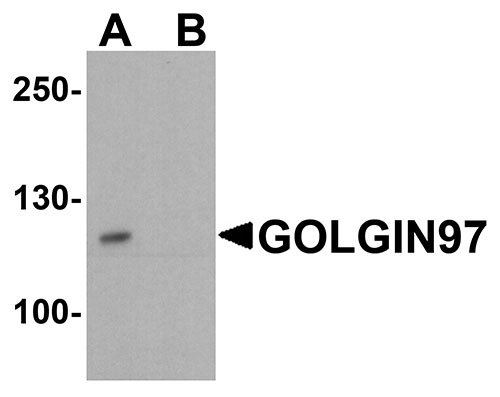
| Calculated MW | Predicted: 84 kDa; Observed: 120 kDa |
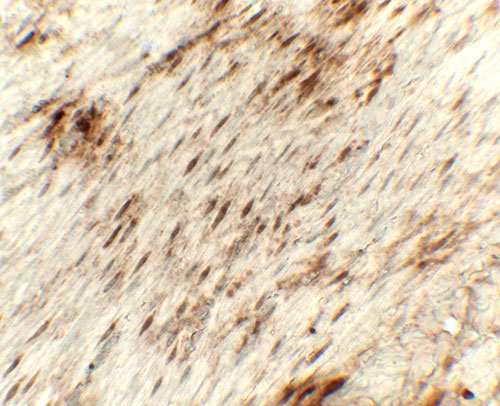
| Application Notes | GOLGIN97 antibody can be used for detection of GOLGIN97 by Western blot at 1 - 2 µg/ml. Antibody can also be used for immunohistochemistry starting at 5 µg/mL. For immunofluorescence start at 20 µg/mL. |
| Gene ID | 2800 |
|---|---|
| Target/Specificity | GOLGA1; GOLGIN97 antibody is human, mouse and rat reactive. At least two isoforms of GOLGIN97 are known to exist; this antibody will detect only the longer isoform. GOLGIN97 antibody is predicted to not cross-react with other GOLGIN family proteins. |
| Reconstitution & Storage | GOLGIN97 antibody can be stored at 4℃ for three months and -20℃, stable for up to one year. |
| Precautions | GOLGIN97 Antibody is for research use only and not for use in diagnostic or therapeutic procedures. |
| Name | GOLGA1 |
|---|---|
| Function | Involved in vesicular trafficking at the Golgi apparatus level. Involved in endosome-to-Golgi trafficking. Mechanistically, captures transport vesicles arriving from endosomes via the protein TBC1D23 (PubMed:29084197, PubMed:38552021). Recognized vesicles are then tethered to the trans-Golgi before subsequent SNARE engagement and vesicle fusion. Selectively regulates E-cadherin transport from the trans-Golgi network in tubulovesicular carriers (PubMed:34969853). |
| Cellular Location | Golgi apparatus membrane; Peripheral membrane protein. Golgi apparatus, trans-Golgi network membrane Cytoplasmic vesicle, secretory vesicle, acrosome {ECO:0000250|UniProtKB:Q9CW79} |

Thousands of laboratories across the world have published research that depended on the performance of antibodies from Abcepta to advance their research. Check out links to articles that cite our products in major peer-reviewed journals, organized by research category.
info@abcepta.com, and receive a free "I Love Antibodies" mug.

Provided below are standard protocols that you may find useful for product applications.
Background
GOLGIN97 was initially isolated as a Golgi complex autoantigen associated with Sjogren’s syndrome, a chronic autoimmune disease in which the body's white blood cells destroy the exocrine glands, specifically the salivary and lacrimal glands (1,2). GOLGIN97 plays a role as a tethering molecule in endosome to the trans-Golgi network (TGN) retrograde traffic (3). FIP1/RCP binding to GOLGIN97 is required for tethering and fusion of recycling endosome retrograde transport vesicles to the TGN (4).
References
Griffith KJ, Chan EK, Lung CC, et al. Molecular cloning of a novel 97-kd Golgi complex autoantigen associated with Sjogren’s syndrome. Arthritis Rheum. 1997; 40:1693-702.
Borchers AT, Naguwa SM, Keen CL, et al. Immunopathogenesis of Sjogren's syndrome. Clin. Rev. Allergy Immunol. 2003; 25:89-104.
Lu L, Tai G, and Hong W. Autoantigen Golgin-97, and effector of ARL1 GTPase, participates in traffic from the endosome to the trans-Golgi network. Mol. Biol. Cell 2004; 15:4426-43.
Jing J, Junutula JR, Wu C, et al. FIP1/RCP binding to Golgin-97 regulates retrograde transport from recycling endosomes to the trans-Golgi network. Mol. Biol. Cell 2010; 21:3041-53.

If you have used an Abcepta product and would like to share how it has performed, please click on the "Submit Review" button and provide the requested information. Our staff will examine and post your review and contact you if needed.
If you have any additional inquiries please email technical services at tech@abcepta.com.

Ordering Information
Other Products
Shipping Information