






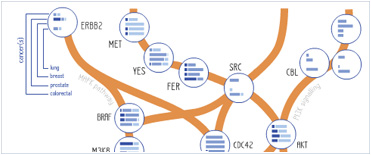








 Foundational characteristics of cancer include proliferation, angiogenesis, migration, evasion of apoptosis, and cellular immortality. Find key markers for these cellular processes and antibodies to detect them.
 The SUMOplot™ Analysis Program predicts and scores sumoylation sites in your protein. SUMOylation is a post-translational modification involved in various cellular processes, such as nuclear-cytosolic transport, transcriptional regulation, apoptosis, protein stability, response to stress, and progression through the cell cycle.
 The Autophagy Receptor Motif Plotter predicts and scores autophagy receptor binding sites in your protein. Identifying proteins connected to this pathway is critical to understanding the role of autophagy in physiological as well as pathological processes such as development, differentiation, neurodegenerative diseases, stress, infection, and cancer.
IRX3 Antibody (monoclonal) (M03)
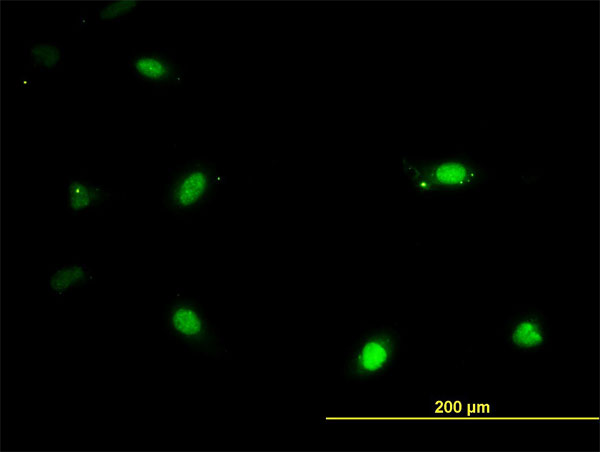
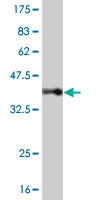
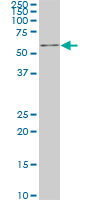
Mouse monoclonal antibody raised against a partial recombinant IRX3.
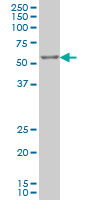
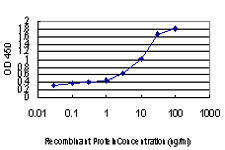
- SPECIFICATION
- CITATIONS
- PROTOCOLS
- BACKGROUND

Application 
| WB, IF, E |
|---|---|
| Primary Accession | P78415 |
| Other Accession | NM_024336 |
| Reactivity | Human |
| Host | Mouse |
| Clonality | Monoclonal |
| Isotype | IgG2a Kappa |
| Clone Names | 3D8 |
| Calculated MW | 52119 Da |
| Gene ID | 79191 |
|---|---|
| Other Names | Iroquois-class homeodomain protein IRX-3, Homeodomain protein IRXB1, Iroquois homeobox protein 3, IRX3, IRXB1 |
| Target/Specificity | IRX3 (NP_077312, 182 a.a. ~ 285 a.a) partial recombinant protein with GST tag. MW of the GST tag alone is 26 KDa. |
| Dilution | WB~~1:500~1000 IF~~1:50~200 E~~N/A |
| Format | Clear, colorless solution in phosphate buffered saline, pH 7.2 . |
| Storage | Store at -20°C or lower. Aliquot to avoid repeated freezing and thawing. |
| Precautions | IRX3 Antibody (monoclonal) (M03) is for research use only and not for use in diagnostic or therapeutic procedures. |

Thousands of laboratories across the world have published research that depended on the performance of antibodies from Abcepta to advance their research. Check out links to articles that cite our products in major peer-reviewed journals, organized by research category.
info@abcepta.com, and receive a free "I Love Antibodies" mug.

Provided below are standard protocols that you may find useful for product applications.
Background
IRX3 is a member of the Iroquois homeobox gene family (see IRX1; MIM 606197) and plays a role in an early step of neural development (Bellefroid et al., 1998 [PubMed 9427753]). Members of this family appear to play multiple roles during pattern formation of vertebrate embryos (Lewis et al., 1999 [PubMed 10370142]).
References
Long-range gene regulation links genomic type 2 diabetes and obesity risk regions to HHEX, SOX4, and IRX3. Ragvin A, et al. Proc Natl Acad Sci U S A, 2010 Jan 12. PMID 20080751.Coeliac disease-associated risk variants in TNFAIP3 and REL implicate altered NF-kappaB signalling. Trynka G, et al. Gut, 2009 Aug. PMID 19240061.The status, quality, and expansion of the NIH full-length cDNA project: the Mammalian Gene Collection (MGC). Gerhard DS, et al. Genome Res, 2004 Oct. PMID 15489334.Generation and initial analysis of more than 15,000 full-length human and mouse cDNA sequences. Strausberg RL, et al. Proc Natl Acad Sci U S A, 2002 Dec 24. PMID 12477932.Regulated expression patterns of IRX-2, an Iroquois-class homeobox gene, in the human breast. Lewis MT, et al. Cell Tissue Res, 1999 Jun. PMID 10370142.

If you have used an Abcepta product and would like to share how it has performed, please click on the "Submit Review" button and provide the requested information. Our staff will examine and post your review and contact you if needed.
If you have any additional inquiries please email technical services at tech@abcepta.com.

Ordering Information
Other Products
Shipping Information