






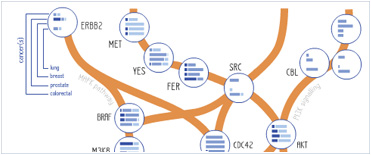








 Foundational characteristics of cancer include proliferation, angiogenesis, migration, evasion of apoptosis, and cellular immortality. Find key markers for these cellular processes and antibodies to detect them.
 The SUMOplot™ Analysis Program predicts and scores sumoylation sites in your protein. SUMOylation is a post-translational modification involved in various cellular processes, such as nuclear-cytosolic transport, transcriptional regulation, apoptosis, protein stability, response to stress, and progression through the cell cycle.
 The Autophagy Receptor Motif Plotter predicts and scores autophagy receptor binding sites in your protein. Identifying proteins connected to this pathway is critical to understanding the role of autophagy in physiological as well as pathological processes such as development, differentiation, neurodegenerative diseases, stress, infection, and cancer.
Human recombinant protein NDRG1
Human Recombinant NDRG1
- SPECIFICATION
- CITATIONS
- PROTOCOLS
- BACKGROUND
| Primary Accession | Q92597 |
|---|---|
| Concentration | 1 |
| Calculated MW | 43.9 kDa (402 aa, 1-394 aa + CT His Tag) |
| Gene ID | 10397 |
|---|---|
| Gene Symbol | NDRG1 |
| Other Names | N-myc downstream regulated 1, CAP43, CMT4D, DRG1, GC4, HMSNL, NMSL, PROXY1, RIT42, RTP, TARG1, TDD5 . |
| Gene Source | Human |
| Source | E. Coli |
| Assay&Purity | SDS-PAGE; ≥95% |
| Assay2&Purity2 | N/A; |
| Recombinant | Yes |
| Results | 0.5 - 1.5 ng/ml |
| Sequence | MSREMQDVDL AEVKPLVEKG ETITGLLQEF DVQEQDIETL HGSVHVTLCG TPKGNRPVIL TYHDIGMNHK TCYNPLFNYE DMQEITQHFA VCHVDAPGQQ DGAASFPAGY MYPSMDQLAE MLPGVLQQFG LKSIIGMGTG AGAYILTRFA LNNPEMVEGL VLINVNPCAE GWMDWAASKI SGWTQALPDM VVSHLFGKEE MQSNVEVVHT YRQHIVNDMN PGNLHLFINA YNSRRDLEIE RPMPGTHTVT LQCPALLVVG DSSPAVDAVV ECNSKLDPTK TTLLKMADCG GLPQISQPAK LAEAFKYFVQ GMGYMPSASM TRLMRSRTAS GSSVTSLDGT RSRSHTSEGT RSRSHTSEGT RSRSHTSEGA HLDITPNSGA AGNSAGPKSM EVSCLEHHHH HH |
| Format | Liquid |
| Storage | -80°C; 1 mg/ml solution in 20 mM Tris-HCl buffer (pH 8.0) containing 0.1 mM PMSF and 10% glycerol. |

Thousands of laboratories across the world have published research that depended on the performance of antibodies from Abcepta to advance their research. Check out links to articles that cite our products in major peer-reviewed journals, organized by research category.
info@abcepta.com, and receive a free "I Love Antibodies" mug.

Provided below are standard protocols that you may find useful for product applications.
Background
NDRG1 is a cytoplasmic protein that is involved in stress responses, hormone responses, cell growth, and differentiation. NDRG1 is one of 4 members of the NDRG α/β-hydrolase family. It is classified as a tumor suppressor and heavy metal-response protein. NDRG1’s functions include cell-cycle regulation, cellular differentiation, apoptosis, hypoxia response and metal-ion sensing. It is also essential for p53-mediated caspase activation and apoptosis. NDRG1 is ubiquitous; it is expressed most notably in placental membranes and prostate, kidney, small intestine, and ovary tissues. NDRG1 has reduced expression in adenocarcinomas compared to normal tissues. NDRG1 gene mutations are reported to be the cause for hereditary motor and sensory neuropathy-Lom (HMSNL), which is a severe autosomal recessive form of Charcot- Marie-Tooth (CMT) disease. In addition, decreased NDRG1 expression in glioma is linked to tumor progression. On the other hand, overexpression of NDRG1 is connected to malignant status of esophageal cancer. NDRG1 may also have a role in portal vein invasion and intrahepatic metastasis in human hepatocellular carcinoma.
References
Kokame K.,et al.J. Biol. Chem. 271:29659-29665(1996).
van Belzen N.,et al.Lab. Invest. 77:85-92(1997).
Zhou D.,et al.Cancer Res. 58:2182-2189(1998).
Piquemal D.,et al.Biochim. Biophys. Acta 1450:364-373(1999).
Ebert L.,et al.Submitted (JUN-2004) to the EMBL/GenBank/DDBJ databases.

If you have used an Abcepta product and would like to share how it has performed, please click on the "Submit Review" button and provide the requested information. Our staff will examine and post your review and contact you if needed.
If you have any additional inquiries please email technical services at tech@abcepta.com.

Ordering Information
Other Products
Shipping Information