






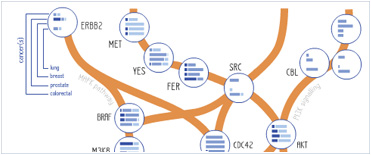








 Foundational characteristics of cancer include proliferation, angiogenesis, migration, evasion of apoptosis, and cellular immortality. Find key markers for these cellular processes and antibodies to detect them.
 The SUMOplot™ Analysis Program predicts and scores sumoylation sites in your protein. SUMOylation is a post-translational modification involved in various cellular processes, such as nuclear-cytosolic transport, transcriptional regulation, apoptosis, protein stability, response to stress, and progression through the cell cycle.
 The Autophagy Receptor Motif Plotter predicts and scores autophagy receptor binding sites in your protein. Identifying proteins connected to this pathway is critical to understanding the role of autophagy in physiological as well as pathological processes such as development, differentiation, neurodegenerative diseases, stress, infection, and cancer.
Human CellExp DKK-1, Human recombinant protein
Dickkopf-related protein-1, Dickkopf-1, SK
- SPECIFICATION
- CITATIONS
- PROTOCOLS
- BACKGROUND
| Primary Accession | O94907 |
|---|---|
| Calculated MW | 35-40 kDa |
| Gene ID | 22943 |
|---|---|
| Gene Symbol | DKK-1 |
| Other Names | Dickkopf-related protein-1, Dickkopf-1, SK |
| Gene Source | Human |
| Source | HEK 293 cells |
| Assay&Purity | SDS-PAGE; ≥97% |
| Assay2&Purity2 | HPLC; |
| Recombinant | Yes |
| Sequence | TLNSVLNSNA IKNLPPPLGG AAGHPGSAVS AAPGILYPGG NKYQTIDNYQ PYPCAEDEEC GTDEYCASPT RGGDAGVQIC LACRKRRKRC MRHAMCCPGN YCKNGICVSS DQNHFRGEIE ETITESFGND HSTLDGYSRR TTLSSKMYHT KGQEGSVCLR SSDCASGLCC ARHFWSKICK PVLKEGQVCT KHRRKGSHGL EIFQRCYCGE GLSCRIQKDH HQASNSSRLH TCQRH |
| Target/Specificity | DKK-1 |
| Application Notes | Centrifuge the vial prior to opening. Reconstitute in water to a concentration of 0.1-1.0 mg/ml. Do not vortex. This solution can be stored at 2-8°C for up to 1 week. For extended storage, it is recommended to further dilute in a buffer containing a carrier protein (example 0.1% BSA) and store in working aliquots at -20°C to -80°C. |
| Format | Lyophilized powder |
| Storage | -20°C; Sterile filtered through a 0.2 micron filter. Lyophilized from 1X PBS, pH 7.5. |

Thousands of laboratories across the world have published research that depended on the performance of antibodies from Abcepta to advance their research. Check out links to articles that cite our products in major peer-reviewed journals, organized by research category.
info@abcepta.com, and receive a free "I Love Antibodies" mug.

Provided below are standard protocols that you may find useful for product applications.
Background
DKK-1 is a member of the DKK protein family which also includes DKK-2, DKK-3 and DKK-4. DKK-1 was originally identified as a Xenopus head forming molecule that behaves as an antagonist for Wnt signaling. Subsequent studies have shown that DKK-1 and DKK-4 play an important regulatory role in the Wnt /β-catenin signaling pathway by forming inhibitory complexes with LDL receptor-related proteins 5 and 6 (LRP5 and LRP6), which are essential components of the Wnt/β catenin signaling system. LPR5 and LPR6 are single-pass transmembrane proteins that appear to act as co-receptors for Wnt ligands involved in the Wnt/β catenin signaling cascade. It has been suggested that by inhibiting Wnt/β catenin signaling, which is essential for posterior patterning in vertebrates, DKK-1 permits anterior development. This notion is supported by the finding that mice deficient of DKK-1 expression lack head formation and die during embryogenesis. Recombinant human DKK-1 expressed in human 293 cells is a 35-40 kDa glycoprotein containing 235 amino-acid residues.
References
Fedi P.,et al.J. Biol. Chem. 274:19465-19472(1999).
Krupnik V.E.,et al.Gene 238:301-313(1999).
Tate G.,et al.Submitted (NOV-1998) to the EMBL/GenBank/DDBJ databases.
Roessler E.,et al.Cytogenet. Cell Genet. 89:220-224(2000).
Clark H.F.,et al.Genome Res. 13:2265-2270(2003).

If you have used an Abcepta product and would like to share how it has performed, please click on the "Submit Review" button and provide the requested information. Our staff will examine and post your review and contact you if needed.
If you have any additional inquiries please email technical services at tech@abcepta.com.

Ordering Information
Other Products
Shipping Information