














 Foundational characteristics of cancer include proliferation, angiogenesis, migration, evasion of apoptosis, and cellular immortality. Find key markers for these cellular processes and antibodies to detect them.
 The SUMOplot™ Analysis Program predicts and scores sumoylation sites in your protein. SUMOylation is a post-translational modification involved in various cellular processes, such as nuclear-cytosolic transport, transcriptional regulation, apoptosis, protein stability, response to stress, and progression through the cell cycle.
 The Autophagy Receptor Motif Plotter predicts and scores autophagy receptor binding sites in your protein. Identifying proteins connected to this pathway is critical to understanding the role of autophagy in physiological as well as pathological processes such as development, differentiation, neurodegenerative diseases, stress, infection, and cancer.
ARSB Antibody
- SPECIFICATION
- CITATIONS
- PROTOCOLS
- BACKGROUND

Application 
| WB, IHC-P, IF, E |
|---|---|
| Primary Accession | P15848 |
| Other Accession | NP_000037, 38569405 |
| Reactivity | Human, Mouse, Rat |
| Host | Rabbit |
| Clonality | Polyclonal |
| Isotype | IgG |
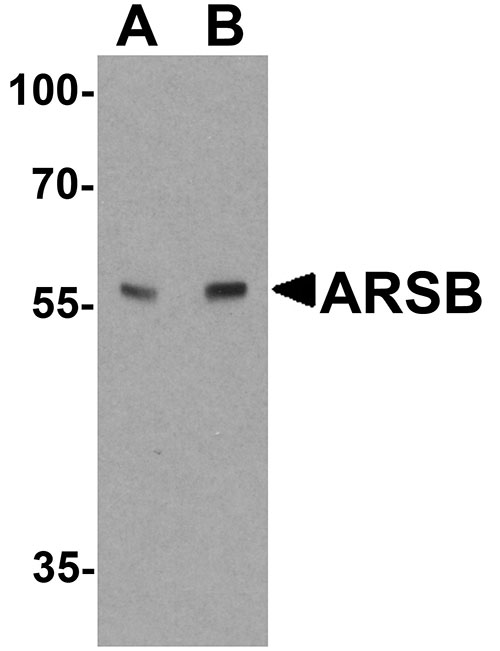
| Calculated MW | Predicted: 59 kDa Observed: 57kDa |
| Application Notes | ARSB antibody can be used for detection of ARSB by Western blot at 1 - 2 µg/ml. |
| Gene ID | 411 |
|---|---|
| Target/Specificity | ARSB; ARSB antibody is human, mouse and rat reactive. At least two isoforms of ARSB are known to exist; this antibody only recognizes the longest isoform. |
| Reconstitution & Storage | ARSB antibody can be stored at 4℃ for three months and -20℃, stable for up to one year. |
| Precautions | ARSB Antibody is for research use only and not for use in diagnostic or therapeutic procedures. |
| Name | ARSB |
|---|---|
| Function | Removes sulfate groups from chondroitin-4-sulfate (C4S) and regulates its degradation (PubMed:19306108). Involved in the regulation of cell adhesion, cell migration and invasion in colonic epithelium (PubMed:19306108). In the central nervous system, is a regulator of neurite outgrowth and neuronal plasticity, acting through the control of sulfate glycosaminoglycans and neurocan levels (By similarity). |
| Cellular Location | Lysosome {ECO:0000250|UniProtKB:P50429}. Cell surface {ECO:0000250|UniProtKB:P50429} |

Thousands of laboratories across the world have published research that depended on the performance of antibodies from Abcepta to advance their research. Check out links to articles that cite our products in major peer-reviewed journals, organized by research category.
info@abcepta.com, and receive a free "I Love Antibodies" mug.

Provided below are standard protocols that you may find useful for product applications.
Background
Aryl sulfatase B (ARSB) forms a homodimer that hydrolyzes sulfate groups of N-Acetyl-D-galactosamine, chondriotin sulfate, and dermatan sulfate (1). ARSB localizes to the lysozyme as well as to the extracellular matrix (2). Mucopolysaccharidosis type VI is an autosomal recessive lysosomal storage disorder resulting from a deficiency of arylsulfatase B (3), and can be treated with exogenous ARSB (4).
References
Wasserman SI and Austen KF. Arylsulfatase B of human lung. Isolation, characterization, and interaction with slow-reacting substance of anaphylaxis. J. Clin. Invest. 1976; 57:738-44.
Mitsunaga-Nakatsubo K, Kusunoki S, Kawakami H, et al. Cell-surface arylsulfatase A and B on sinusoidal endothelial cells, hepatocytes, and Kupffer cells in mammalian livers. Med. Mol. Morphol. 2009; 42:63-9.
Valayannopoulos V, Nicely H, Harmatz P, et al. Mucopolysaccharidosis VI. Orphanet. J. Rare Dis. 2010; 5:5.
Harmatz P, Whitley CB, Waber L, et al. Enzyme replacement therapy in mucopolysaccharidosis VI (Maroteaux-Lamy syndrome). J. Pediatr. 2004; 144:574-80.

If you have used an Abcepta product and would like to share how it has performed, please click on the "Submit Review" button and provide the requested information. Our staff will examine and post your review and contact you if needed.
If you have any additional inquiries please email technical services at tech@abcepta.com.

Ordering Information
Other Products
Shipping Information